Understanding NBCE
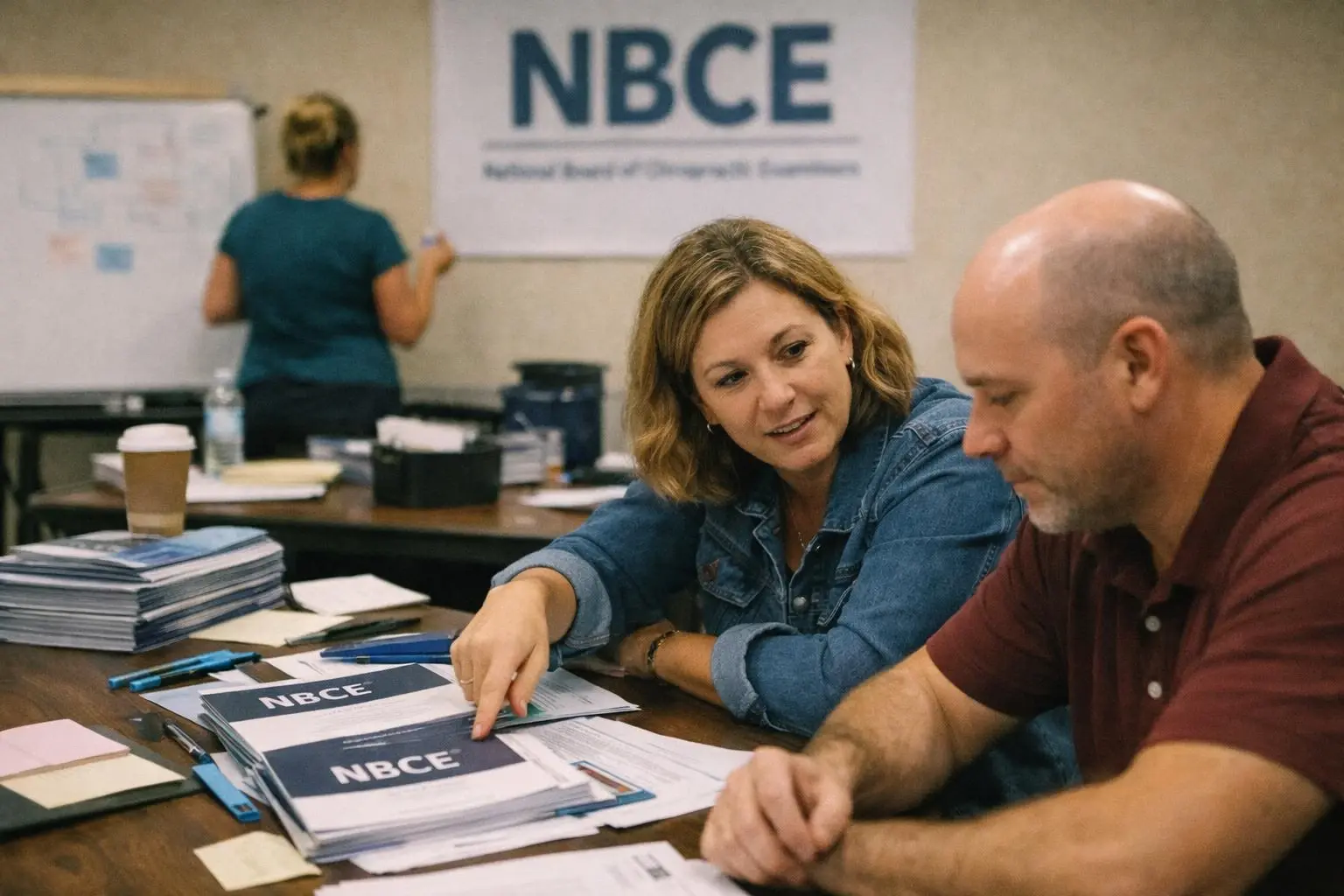
The National Board of Chiropractic Examiners (NBCE) is an independent, nonprofit organization founded in 1963 to create uniform testing standards for the chiropractic profession. Before the NBCE existed, each state developed its own licensing exams, leading to inconsistencies in what chiropractors needed to know. The NBCE developed a set of standardized exams that most states now accept as proof of competency, making it easier for chiropractors to become licensed and practice across state lines.
Related glossary terms: Chiropractic License, Chiropractic Board Certification, Chiropractic Adjustment.
NBCE exams are designed to assess whether chiropractic students and graduates possess the knowledge and skills necessary to provide safe, effective care. The exams cover a broad range of topics, including anatomy, physiology, pathology, diagnosis. And chiropractic techniques. Because chiropractic care involves hands-on spinal adjustments and patient management, the NBCE also includes practical exams that test clinical skills, such as patient examination and spinal manipulation.
How NBCE Exams Work?
NBCE exams are divided into several parts, each focusing on different aspects of chiropractic education and practice. Part I tests basic sciences, such as anatomy, chemistry. And microbiology. Part II covers clinical sciences, including diagnosis, neurology. And chiropractic principles. Part III assesses case management and clinical decision-making. While Part IV evaluates hands-on skills like spinal adjustment techniques and diagnostic imaging interpretation. Some states also require additional exams, such as physiotherapy or state-specific jurisprudence tests. But the NBCE exams form the core of most licensing requirements.
A common issue is The NBCE administers exams multiple times a year at testing centers across the country. Students typically take Part I and Part II during their chiropractic education. While Part III and Part IV are taken after graduation. Each exam is scored on a pass/fail basis, with a minimum passing score set by the NBCE. But individual states may require higher scores or additional exams. So chiropractors must check their state’s licensing board for specific requirements. The NBCE also offers optional exams, such as the Special Purposes Examination for Chiropractic (SPEC), which some states use for license reciprocity or reinstatement.
Why NBCE Matters?

NBCE exams play a critical role in ensuring public safety and maintaining professional standards in chiropractic care. By requiring chiropractors to demonstrate competency in both scientific knowledge and clinical skills, the NBCE helps protect patients from unsafe or unqualified practitioners. The exams also promote consistency across the profession, ensuring that chiropractors in different states meet the same minimum standards. This consistency is especially important for patients who move or seek care from chiropractors in multiple states.
For chiropractors, passing NBCE exams is a key step in obtaining a license to practice. Without NBCE certification, graduates can't legally work as chiropractors in most states. The exams also serve as a benchmark for chiropractic education, guiding schools in curriculum development and ensuring that students are prepared for real-world practice. And some malpractice insurance providers and employers may require proof of NBCE certification, making it an important credential for career advancement.
When NBCE Matters Most?
NBCE exams become important at several key points in a chiropractor’s education and career. For students, the exams are a major milestone during chiropractic school, with Part I and Part II often required before advancing to clinical training. Graduates must pass Part III and Part IV to qualify for state licensure, making these exams critical for starting a practice. Chiropractors who move to a new state may also need to provide NBCE scores as part of the license transfer process, especially if the new state has different requirements.
NBCE certification also matters for chiropractors seeking specialty certifications or advanced credentials. Many postgraduate programs and specialty boards, such as those for chiropractic neurology or sports medicine, require NBCE exam scores as part of their application process. And chiropractors who let their licenses lapse may need to retake NBCE exams to regain their credentials. For patients, NBCE certification provides assurance that their chiropractor has met rigorous national standards for competency and safety.